What are the differences in the production process of embossed aluminum plates with different textures?
The core of the texture difference of embossed aluminum sheet (such as orange peel, diamond, five ribs, pointer, etc.) comes from the differential control of three links: mold design, rolling/embossing process parameters and surface pretreatment. The structural complexity and application requirements of different textures are different, which leads to significant differences in "mold preparation, pressure/speed matching and surface treatment accuracy". The key process differences of different types of textures are compared from the process core dimension, and the common processes and special requirements are summarized:
First, make it clear: the common production process of embossed aluminum plate.
Regardless of the texture, the basic production logic of embossed aluminum sheet is the same, and it is based on the framework of "aluminum sheet substrate pretreatment → embossing forming → post-treatment", with the differences concentrated in the middle embossing forming link and the matching pretreatment/post-treatment adjustment:
Substrate pretreatment: cold-rolled plates of pure aluminum (series 1) or aluminum alloy (series 3 and 5, such as 3003 and 5052) are selected, and the surface cleanliness (avoiding impurities from affecting embossing adhesion) is ensured by degreasing (removing surface oil stains) → pickling (removing oxide film) → washing → drying;
Embossing: the core differentiation link, which transfers the texture to the surface of aluminum plate through "rolling embossing" or "compression molding";
Post-treatment: "anodizing (to enhance corrosion resistance, suitable for outdoor use), spraying (to increase color and wear resistance) and covering with film (to protect the texture from being scratched)" according to the purpose, and some textures need special post-treatment matching.
Second, the core process differences of different textures: from "mold" to "parameter" precise control.
The structural complexity (plane/solid, fine lines/coarse lines), depth (shallow lines ≤0.1mm/deep lines ≥0.2mm) and uses (decoration/anti-skid/heat dissipation) of different textures directly determine the differences in process design. The following are classified and analyzed by "common texture types":
Typical uses of texture types Key process differences (compared with other textures) Key process parameter control
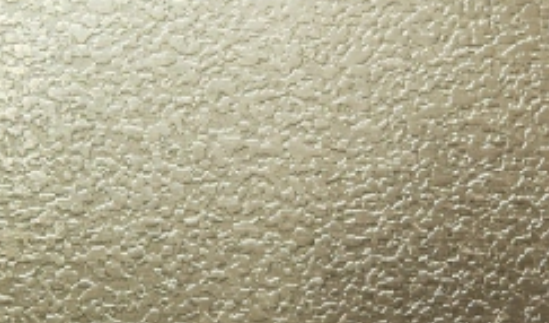
1. Orange peel pattern (fine lines) decorative panel (household appliance shell, indoor ceiling) and electronic equipment shell-mold: "sandblasting carving mold" is adopted, and the surface of the mold is uniform and fine (particle diameter is 50~100μm), and the texture is directionless;
-Molding method: "cold rolling continuous embossing" is often used (high efficiency, suitable for mass production), and secondary grain trimming is not needed;
-Surface pretreatment: The surface smoothness of the substrate is required to be high (error ≤0.05mm/m) to avoid uneven texture depth. -rolling pressure: 5~8MPa (too low pressure makes the texture unclear, and too high pressure makes the substrate easy to deform);
-Rolling speed: 8~12m/min (too fast will easily lead to blurred texture);
-Post-treatment: preferential anodizing (fine texture can highlight the luster of oxide layer).
2. Diamond pattern (grid-like deep pattern) anti-skid panel (stair pedal, carriage floor) and curtain wall decoration-mold: CNC milling mold is adopted, and the surface of the mold is staggered diamond bosses (the length of the diamond side is 10~20mm, and the height of the bosses is 0.2~0.3mm), with strong texture directionality;
-Forming method: "multi-pass embossing" is required (first embossing and shaping, second embossing and trimming to avoid burr on diamond edge);
-Selection of substrate: thick substrate (thickness ≥1.5mm) is preferred to avoid substrate breakage during embossing. -embossing pressure: 12~15MPa (enough pressure is needed to make the substrate completely fit the die boss);
-embossing temperature: normal temperature (thick substrate does not need to be heated, and thin substrate needs to be preheated to 50~60℃ to prevent cracking);
-Post-treatment: "deburring" is needed (the diamond-shaped edge is polished with sandpaper to avoid scratching), and an anti-slip coating can be made (enhancing the friction coefficient).
3. Five ribs (linear groove pattern) radiating panel (LED lamps, motor housing) and non-slip floor-mold: "rolling mold" is adopted, and the surface of the mold is parallel grooves (groove width is 1~2mm, depth is 0.15~0.2mm, and spacing is 5~8mm), and the texture is linearly distributed;
-Forming method: "one-way rolling embossing" (the grain direction is consistent with the rolling direction to ensure uniform groove depth);
-Accuracy requirements: the groove depth error is ≤0.02mm (which affects the heat dissipation efficiency, and the heat dissipation is poor if it is too shallow, and the strength of the substrate decreases if it is too deep). -Rolling pressure: 10~12MPa (focus on controlling the pressure at the bottom of the groove to avoid pressing through);
-Rolling speed: 6~8m/min (too fast speed will easily lead to uneven groove edge);
-Post-treatment: surface sandblasting (enhancing heat dissipation area), and film covering (affecting heat dissipation) is prohibited.
4. Pointer lines (radial fine lines) High-end decoration (furniture panel, elevator door panel)-mold: "laser engraving mold" is adopted, and the surface of the mold is radial fine lines (spreading outward from the center, with a line width of 0.05~0.1mm and a spacing of 0.1~0.2mm) with high texture complexity;
-Forming method: "sectional embossing+splicing" (the range of single embossing is limited, and multi-section splicing is needed to ensure the alignment of radiation centers);
-Surface pretreatment: the substrate needs mirror polishing (Ra≤0.2μm) to highlight the three-dimensional sense of the pointer pattern. -embossing pressure: 6~8MPa (the pressure should be uniform to avoid local texture fracture);
-embossing temperature: room temperature (high temperature can easily lead to fine lines deformation);
-Post-treatment: vacuum coating (such as titanium plating and chromium plating to enhance the decorative effect), and the radiation center needs to be protected (to avoid stitching marks).
Third, the technical difficulties and solutions of special texture
Some textures need to break through the conventional process because of "special structure" or "harsh use". Common difficulties and countermeasures are as follows:
1. Ultra-deep texture (depth ≥0.5mm, such as three-dimensional relief pattern)
Difficulties: the substrate is easy to crack (local overstretching during embossing) and the texture edge is easy to collapse (uneven pressure).
Solution:
Substrate pretreatment: adopting "softening annealing" (heating the aluminum plate to 300~350℃ and keeping the temperature for 1h to reduce the hardness and enhance the ductility);
Forming technology: "progressive embossing" (gradually deepening the texture in 3~5 passes, and increasing the pressure by 2~3MPa in each pass to avoid one-time overstretching);
Die design: the die boss makes "arc transition" (edge fillet R0.1~0.2mm to reduce stress concentration of substrate).
2. Irregular texture (irregular shape, such as logo custom pattern)
Difficulties: the precision of texture edge is low (jagged easily) and the consistency of mass production is poor.
Solution:
Mould: adopt "high-precision 3D printing mould" (accuracy up to ±0.01mm, restoring special-shaped details);
Forming: "constant temperature and constant pressure embossing" (control temperature 60~70℃, pressure 8~10MPa, keep stable);
Detection: The texture accuracy of each batch of samples is detected by "laser profilometer" (the edge sawtooth ≤0.05mm is qualified).
Four, the core principles of process selection
In production, the process should be selected according to "texture characteristics" and "product requirements" to avoid blind application:
Efficiency priority: if it is mass production (such as orange peel pattern household appliances panel), priority should be given to "cold rolling continuous embossing" (fast speed and low cost);
Precision priority: if it is a high-precision texture (such as a pointer pattern decorative board), choose "laser engraving mold+segmented embossing" (to ensure the restoration of details);
Performance priority: If it is a functional texture (such as a five-rib radiator), the "texture depth and uniformity" should be controlled, and the post-treatment should match the performance requirements (such as sandblasting for heat dissipation and coating for anti-skid).
To sum up, the process difference of embossed aluminum sheets with different textures is the exact match of "mold design, molding parameters and post-treatment" and "texture structure and application requirements". In production, "pretreatment control precision, molding control parameters and post-treatment control performance" are needed to ensure clear texture and up-to-standard performance.